Aroygyaaan
A farm to door organic food delivery platform built to remove middlemen, restore trust in food sourcing, and make eating well genuinely easy.
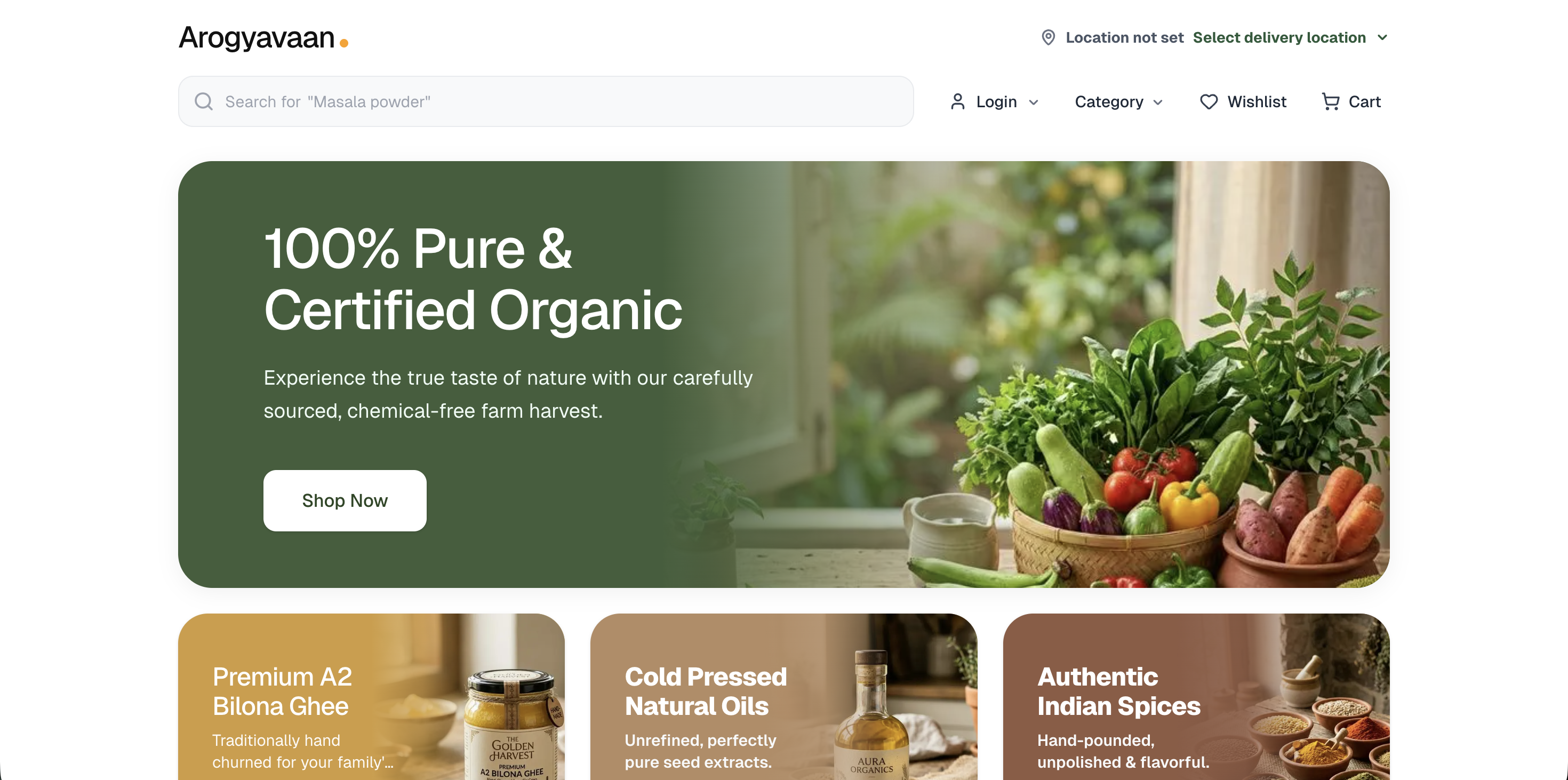
The food supply chain is broken, and most people don't even know it.
Walk into any supermarket and pick up a packet of "organic" vegetables. Chances are, those vegetables passed through at least three or four hands before they reached the shelf — each adding cost, each adding time, and each quietly eroding the quality that "organic" is supposed to guarantee.
Local farmers — the people actually growing the food — are often the last to benefit from that chain. They sell at low fixed prices to aggregators, who mark up and sell to distributors, who sell to retailers, who mark up again before it reaches you. By the time money cycles back to the farmer, the margin is thin. So thin that many switch to cheaper, chemical-assisted farming to stay afloat. The very thing consumers are paying a premium to avoid.
I wanted to build something that cuts that chain short — a platform where a farmer can list what they have, and a buyer can order it directly. Honest pricing. Traceable produce. No mystery in the middle.
Two very different people, one shared need.
Aroygyaaan is built for two types of users who rarely get to interact directly.
The farmer — usually based in a semi-rural area, growing certified or naturally farmed produce. They're skilled growers but not marketers. They need a dead-simple way to list what's available, update inventory, and get paid reliably without navigating complicated systems.
The buyer — typically an urban household that cares about what goes into their food. Comfortable ordering online, but frustrated by the vagueness of mainstream "organic" labels. They want to know where their food came from, have it arrive fresh, and not spend 20 minutes hunting for it across five different tabs.
Start with the flows that matter, ignore the rest.
Before writing a single line of code, I spent the first week mapping out what the platform actually needed to do — not at a feature level, but at a human level. What does a farmer need to feel confident listing their produce? What does a buyer need before they'll trust a stranger's farm with their grocery order?
Three flows emerged as non-negotiable: farmer onboarding and product listing, buyer browse and checkout, and real-time order tracking. Everything else — reviews, subscription boxes, loyalty points — went into a backlog and stayed there for the first version. Scope creep is how good ideas die slowly.
For the UI, the priority was calm clarity. The visual design needed to communicate freshness and trust without leaning into tired "green = eco" clichés. Lots of whitespace, honest photography, and a muted earthy palette that felt premium without feeling cold.
Boring technology is often the right technology.
I reached for Next.js 15 with the App Router not because it was new, but because server components, nested layouts, and built-in route caching made the product feel fast without a lot of manual optimization work. Pages that don't need to be dynamic aren't — which matters a lot on mobile data connections.
React 19's concurrent features helped a lot on the listing and cart pages where multiple pieces of state update in quick succession. Framer Motion handled the micro-animations — product card reveals, cart slide-ins, confirmation toasts — keeping interactions feeling physical and intentional rather than abrupt.
Tailwind CSS kept styling consistent and fast to iterate on. When I had a design question mid-build, I could tweak values and see results in seconds rather than hunting across multiple stylesheets. As a solo developer on a time-boxed project, that speed matters.
The hard parts were never the ones I expected.
The trickiest part wasn't building the checkout flow or the order tracker — it was figuring out inventory management. Farmers don't deal in fixed SKUs. What's available changes week to week based on harvest, weather, and demand. Building a system flexible enough to handle that uncertainty, but structured enough to prevent overselling, required more thought than I originally budgeted.
The solution was a simple availability model with a "soft reserve" on add-to-cart and a confirm-before-dispatch step that gives farmers a window to flag anything that's no longer available. Not perfect, but honest — and that honesty builds more trust than a complex automated system that sometimes gets it wrong silently.
The other challenge was mobile performance on lower-end Android devices. Next.js image optimization helped, but I also had to be disciplined about animation complexity — defaulting to simpler transitions for users on marginal connections or who had prefers-reduced-motion enabled.
What building this actually taught me.
The biggest lesson wasn't technical. It was about restraint. There are at least a dozen features I wanted to build — a subscription model, a community review system, a seasonal produce calendar, recipe integration. None of them made it into v1. And the product is better for that.
When you're building alone on a deadline, every extra feature is a tax on everything else. The checkout flow got sharper because I wasn't also building reviews. The listing UX got more considered because I wasn't splitting attention across six new ideas at once.
I also came away with a much more grounded understanding of what "full-stack" actually means in practice — not just owning both the front end and the API, but making decisions that cut across both layers simultaneously. Performance, data shape, error handling — they all have to be coherent from database to browser, and that coherence is harder to maintain than it looks from the outside.
Built with Passion
© 2026 Built with ❤️ & Code by Nishal Poojary.
The Land of Spirituality and Philosophy
Bangalore · India
Thanks for making it
to the end 🙌🏻
